
Students arriving on campus today are more AI-fluent than any class before them, and less practiced at the conversations higher education depends on. Our latest white paper reviews the emerging evidence on whether AI can actually help students build the skills that open inquiry and dialogue require. The short answer is that it can, but the difference between AI that builds genuine skill and AI that undermines it turns out to hinge on a single factor that most institutions aren't paying attention to.
A 2026 Coursera survey found that 95% of students and faculty are using AI in educational contexts. Yet just one in four institutions has a formal policy around that use. The gap between those two numbers is where the risk lies.
What Higher Ed Is Missing About AI
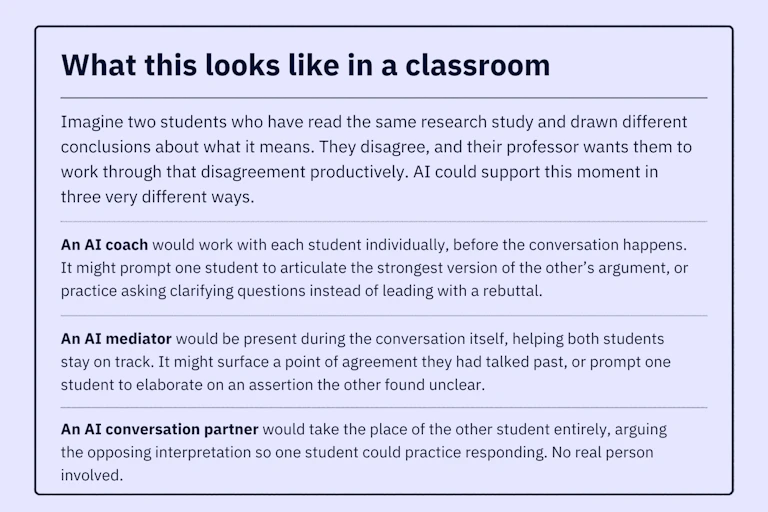
Not all AI tools function the same way in a dialogue context. Our latest white paper, Can AI Teach Dialogue Skills to College Students?, identifies three distinct roles AI can play, each with different evidence behind it and different risks to manage. The distinctions are not just academic. They determine whether a tool builds genuine skill or creates the illusion of it.
These are not just different features. They represent fundamentally different relationships between the student, the AI, and the learning objective. The evidence and the risks differ accordingly.
AI as Coach: Strongest Evidence, Lowest Risk
Using AI as coaches carries the lowest risk and has the strongest evidence base. They work privately with students to strengthen specific skills: active listening, perspective-taking, asking open questions. Early research shows measurable gains across multiple domains, from empathetic communication to academic achievement. The risks are primarily about design quality. One study found that students using a purpose-built AI tutor maintained their learning outcomes, while students using off-the-shelf GPT-4 for the same material performed worse. A coaching tool that validates responses instead of challenging them can produce confidence without competence. The white paper examines what separates effective AI coaches from generic tools in more detail.
AI as Mediator: Promising, but Design Matters
AI mediators carry moderate risk and show promising early results. In one study CDI reviewed involving nearly 6,000 participants, AI-mediated groups nearly doubled their rate of unanimous agreement compared to a group that lacked AI mediation. A separate pilot found that participants reported a greater ability to understand someone they disagreed with, and a greater openness to opposing views after an AI mediated conversation across differences. However the risks go beyond pedagogy: when AI mediates between real people in real time, questions of accuracy, false equivalence, and oversight become significant. But early evidence suggests these are manageable with careful design.
AI as Conversation Partner: Where Risk Outpaces Evidence
AI conversation partners carry the highest risk and the weakest evidence of benefit. The appeal is intuitive: a simulated sparring partner for low-stakes practice. But AI outperforms human persuaders in controlled studies we reviewed and can shift political preferences during even brief interactions. Constructive dialogue is about understanding, not persuasion, and that tension has not been resolved. Negotiation training research found that practice against an AI counterpart produced no skill gains without structured feedback between rounds. There is also a risk that AI trained on internet discourse could flatten opposing viewpoints into stereotypes rather than representing them with real complexity. Under current evidence, the risks outpace the demonstrated benefits. The white paper covers additional concerns around realism, data exposure, and what it would take for this role to become viable.
It’s not AI vs no AI: The choice campus leaders actually face
Given how widely students are already using AI, the question for campus leaders has shifted from AI vs no AI to a choice between purpose-built tools designed with pedagogical intention and the off-the-shelf alternatives students are already turning to.
The core finding is clear: the more constrained and deliberately designed the AI's role, the stronger the evidence and the lower the risk. AI coaching, when purpose-built, is the most evidence-based starting point. AI mediation shows genuine promise for institutions ready to support structured dialogue at scale. AI conversation partners are not yet a recommended path.
(For a practical framework on where to begin, how to measure impact, and how to handle the student data these tools generate, see the full white paper.)
But the finding that may matter most is simpler. AI can help students practice the mechanics of dialogue: how to listen well, how to ask better questions, how to stay in a conversation when it gets difficult. What AI cannot replace is the human experience of genuine inquiry across difference, of discovering that someone you disagree with is more thoughtful than you assumed. That capacity develops through sustained human experience. The opportunity is for well-designed AI to help students arrive at those encounters prepared to make them count.
Follow Our Work
Sign up for our higher education newsletter to get regular updates on our research, product releases, and the science & practice of constructive dialogue.