Preparing for Election Season
Strategies for Faculty & Staff

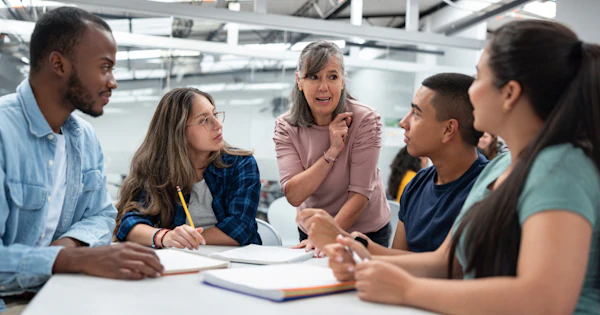
Student experiences are shaped by their day-to-day interactions with faculty and staff. Before elections, offering low-stakes dialogue opportunities provides students with a platform to express their viewpoints, engage in respectful discourse, and refine their communication skills in a non-confrontational environment.
By participating in such exercises, students can develop skills in listening, asking questions, explaining their perspectives, and responding constructively to disagreement.This practice fosters a culture of open dialogue and mutual respect, ultimately contributing to a more informed and engaged electorate capable of constructive political discourse. The following are some suggestions for cultivating constructive dialogue in curricular and co-curricular environments.
Establish election-related norms with students
Complement campus-wide policies with shared norms, common values, and a network of trust. Classroom or program norms fortify a structure for dialogue and social cohesion, which are essential precursors for political discussions.
At the beginning of students’ engagement with each other, be it in a classroom or co-curricular setting, set clear expectations for respectful and civil dialogue. Ask students about the election topics they care about and those that worry or rile them. The Institute for Democracy & Higher Education (IDHE) finds that two agreements are critical: “Assume good will” and “Share responsibility for the quality of the discussion.”
Foster student agency
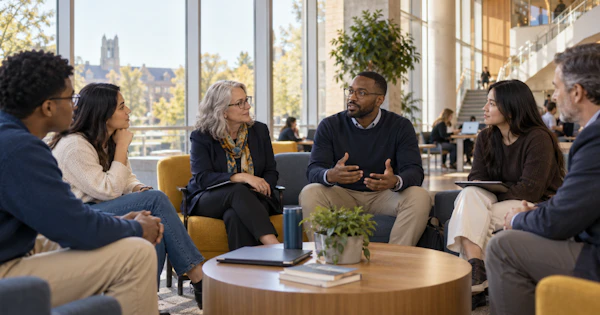
Administration, faculty, and staff need to create the structures for dialogue across differences, but successful civic engagement requires student ownership.
At the University of Delaware, the Blue Hen poll is an annual public opinion survey conducted by students for students. We heard several instances of peaceful, even joyful, counterprogramming, attributed by interviewees to the organic nature of being student led.

Prepare for the day after
Use existing communication and student-support systems to understand what students may need before and after the election. Ask students directly rather than assuming how they will respond to election-related developments or results.
Coordinate with relevant campus offices so faculty and staff know where to direct students who request additional support. Clearly communicate what resources are available, how students can access them, and what kinds of assistance each resource provides.
Introduce low-stakes practice opportunities
Encourage students to attend election-oriented events and programs and to report back by asking questions, challenging assumptions, and providing evidence to support their arguments. Source articles from the student newspaper. Start these discussions before the election. Be aware of your own political leanings when interacting with students. Review your teaching or program materials to avoid any perception of bias in your classroom or student-facing discussions. Make it a habit to use examples from across the political spectrum.

"What kinds of programming can you put in place to grow the muscle that you will need to sustain you through the result? What can you do as a parallel to the election that isn’t so focused on the election–but it is focused in a constructive way on other issues in the country, in our civic space, in our democracy–where students might be able to see a more constructive path for their own engagement?”
President
Initiate dialogue across differences during orientation
Introduce dialogue across differences during orientation to lay the foundation for constructive engagement on campus. Extend this initiative beyond orientation into academic and co-curricular realms, integrating dialogue training into various programs such as first-year seminars, student leadership initiatives, and residence life activities.
By doing so, institutions foster interconnected pathways that promote civil discourse throughout students' college experience.
Situate election events into residence life
The immersive experience of residential campus life stands out as one of the rare settings where community members gain abundant practice opportunities amid individuals with diverse perspectives. It serves as an environment where encountering disagreements is expected, and how these disagreements manifest significantly shapes campus culture. Yet it is also a space where the absence of room for respectful disagreement can result in irreversible alienation. As such, the election becomes a pivotal juncture for institutions to showcase the value of fostering dialogue and understanding within their academic communities.
Living learning communities can examine election issues important to their residential themes. Post-debate discussions or issue-oriented presentations with local or on-campus experts can entice students while also demonstrating respect for a range of viewpoints and expertise. These programs provide an opportunity to include counseling and psychological services, thus raising awareness of other resources, both generally and post-election. One institution we spoke with has integrated restorative practices into residence life. Resident leaders are trained in circle practices and are given engagement guidelines, which empower students to address conflicts on their own. The institution phased in these techniques, initially targeting a small group before expanding them campus-wide with secured funding.

"I say to students in our orientation program, my expectation is that you’re going to find the person in your residence hall whose life experiences are most different from your own and form a friendship right on our campus. When somebody says something you find deeply politically insulting, we expect you to take them out for coffee. Don’t ask about their politics, but ask about their life.”
President
Foster media & AI literacy and critical thinking
Efforts to combat misinformation sometimes inadvertently exacerbate ideological divisions rather than bridging them. When students distrust the source of a correction, the correction can harden the belief it was meant to change.
The rise of generative AI has made this more pressing. Two thirds of U.S. adults say they are highly concerned about people getting inaccurate information from AI, and students now encounter fabricated text, images, and video that can look indistinguishable from the real thing. Hence, it's imperative to cultivate critical thinking skills and champion evidence-based arguments. Give students regular practice tracing a claim to its source, weighing the evidence behind it, and explaining their reasoning to someone who sees it differently.
Leading by example, demonstrate transparency by divulging your own sources and methods of information verification. Emphasize active engagement with diverse sources of information rather than passive consumption. Combating misinformation entails actively seeking and absorbing more information.
Invest in advanced professional development
Facilitating dialogue across differences requires preparation and practice. Professional development can help faculty and staff establish expectations for discussions, ask constructive questions, respond to tension, and determine when a conversation should be paused or restructured.
For advanced facilitators, consider training in mediation, conflict de-escalation, and restorative practices. Audit your own strengths and deficits. Engage with colleagues to share best practices and strategies.
Embrace novel counterprotest techniques
Encourage students to consider organizing counterprogramming as opposed to counterprotests. For many student groups, a counter program that draws attention away from the controversial speaker is more likely to meet their goals. It is even better if the counterprogram serves to build community or to show support for groups who may feel marginalized by the speaker’s statements.
“[A controversial speaker] was booked to come on campus. The campus leadership had a great conversation about ‘What do we do? We believe in free speech.’ If you believe in free speech, that includes the people you don’t like to hear. So make it clear to [the speaker] they cannot encourage violence. We made that very clear to [the speaker]. And the students, I thought this was so smart. They counterprogrammed at the far end of campus. They had a concert. They had like a little carnival going. So what could have been awful turned into almost a nonevent.” — President

Ask students about their post-election preferences
Avoid assuming what students will need after an election. Before results are announced, ask students what kinds of academic discussion, information, or support would be useful.
Faculty and staff can schedule optional opportunities to discuss the election and its implications. Clearly explain the purpose and format of these conversations, and provide more than one way for students to participate.
Coordinate with relevant campus offices so students can access additional resources when requested. Afterward, gather feedback about what was useful and what the institution could approach differently during future elections.
Explore Our Programs
Build the skills to guide difficult conversations before, during, and beyond election season. CDI offers research-informed programs that help faculty and staff facilitate dialogue, respond to tension, and support constructive engagement across campus.